
Your cells are listening
I recently re-read The Biology of Belief — I'd re-found it doing a much-needed reorganization of my bookshelves. I read it back when it was first published in 2005. And, it more than held up.
The secret of life...
Bruce Lipton, a cell biologist who taught at the University of Wisconsin School of Medicine before moving into research at Stanford, spent years working within the field of epigenetics, studying how cells behave when you change what's happening around them rather than what's written inside them.
 I think of it this way: your DNA sequence is the piano keyboard — fixed, built once. Your epigenetics are analogous to the pianist, deciding which keys get played, in what order, with what dynamic volume.
Same instrument, entirely different music, depending on who's playing.
Lipton describes cells as far more sophisticated than the passive machines we learned about in school — each one reading its environment and adjusting its behavior accordingly. Scale that up, and a human being becomes a cooperative community of trillions of these single-celled citizens, all responding to what the environment — including the internal environment of thought and emotion — is signaling.
He also draws a sharp line between two modes any organism can run in: growth, or protection. A cell directs its energy toward building and repairing, or toward defending against a perceived threat — rarely both at once. Which mode you're in, more often than we'd like to admit, comes down to what you believe is happening around you. He put his central argument more simply than I ever could:
"The 'secret of life' is belief."[1] And it matters far more than you'd think.
 Beliefs shape everything, including how you heal...
This idea isn't actually new to medicine — Sir William Osler, one of the founding figures of modern clinical medicine, drew a distinction that most physicians of his era weren't making: the difference between treating a disease and treating the person who has it. He's credited with the observation that a good physician treats the disease, but "the great physician treats the patient who has the disease."[2]
Two people can receive an identical diagnosis and walk two entirely different roads with it. Some of that is biology in the narrow sense. But some of it — more than conventional medicine has historically been comfortable admitting — is the person's belief about what's happening to them.
Stephen Jay Gould — a Harvard evolutionary biologist — made this case from the other side of the exam table, after being handed a statistical death sentence of his own. As he put it: "variation itself is nature's only irreducible essence."[3]
A statistic describes a population. It cannot describe an individual. You are the variation, not the average — and what you believe about your own odds becomes part of what determines them.
How this lands within my B.I.G.3 framework:
This is precisely the terrain my B.I.G.3 — Blood Sugar, Inflammation, Gut Health™ — lives in, because belief isn't abstract. It's chemistry.
A nervous system that perceives threat — chronically, quietly — keeps cortisol elevated, and cortisol pushes blood sugar up.
A body braced for danger runs a low, steady hum of inflammation.
And the gut, wired directly to the brain through the vagus nerve, is exquisitely sensitive to all of it — motility, permeability, the microbiome itself, shifting in response to what the nervous system believes is happening.[4]
None of that is "just stress." It's measurable physiology, downstream of belief.
The nocebo effect you didn't know you got...
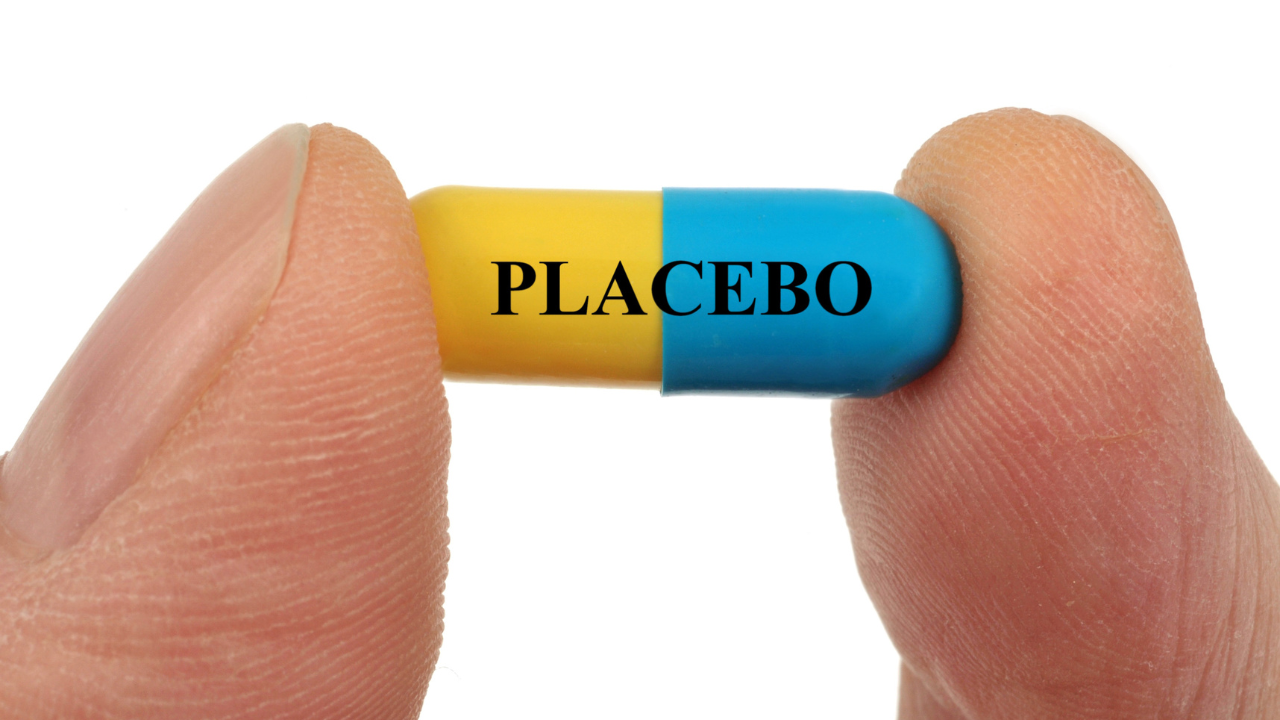
We're all familiar with the placebo effect. Fewer have heard of the nocebo effect —the same expectation-based response, working in reverse.
It's the phenomenon where a person experiences real, measurable negative symptoms or side effects simply because they expect to. A sugar pill can produce it. So can a genuinely effective medication — which means how a treatment gets delivered, the words used to describe it, can shape whether it helps you or works against you.
A study of pain medication remifentanil via IV under three conditions demonstrates both the placebo and nocebo in action:
- no expectation set
- a positive one ("this will reduce your pain"),
- a negative one ("this may increase your pain").
The dose never changed. Telling patients to expect relief roughly doubled the drug's painkilling effect: the placebo effect, boosting a real treatment. Telling them to expect worsening pain wiped out its benefit almost entirely: the nocebo effect, undermining that same real treatment.[5] Same molecule, same dose, two opposite outcomes — depending entirely on how the medication was presented to the patient.
Expectations shape outcome across conditions [6] Which means "this might make you nauseated" and "most people tolerate this really well" can produce measurably different outcomes in the same patient on the same drug.
Belief isn't something that happens after the fact — it's part of the treatment. And it's not confined to prescriptions; I see it just as often in the stories clients bring into the room.
Reading the real story
I'm not a psychologist. But two decades in this field means I've been privy to thousands of stories — the version a client tells me about their body, their history, their life.
Learning to hear what's underneath the story, the belief quietly running the show, has become one of the more essential parts of my practice.
In certain cases I'll ask a client directly: can you see yourself feeling better? Not hope it. Actually see it.
And for clients who feel like they can't gain any ground no matter what we adjust, I'll ask if they're conscious of how they seem to be interpreting the world around them.
Many are unaware of their "lens of discontent" — registering the negative first in almost every situation, everything landing as a struggle, an underlying sense that everyone else has it easier than they do. It's another manifestation of the biology of belief.
Neither question is a diagnosis. But they're often the fastest way to determine out whether the biology I'm working on has a belief quietly working against it.

So, how's your lens?
Obviously, your thoughts alone won't resolve disappointing labs. But the story you tell yourself about your body — safe or under siege, capable or fragile, listened to or dismissed — isn't separate from your blood sugar, your inflammatory load, or your gut. It's woven into all three.
So here's the question worth sitting with: what are you currently telling your body to believe? And is it true?
I'd love to hear what comes up for you.
TL;DR
- Belief is biology, not metaphor: DNA is the keyboard; epigenetics is the pianist deciding what gets played.
- Medicine has long known this: Osler and Gould both remind us the patient matters more than the diagnosis.
- It shows up in the B.I.G.3: Perceived threat keeps blood sugar up, inflammation simmering, and the gut unsettled.
- Placebo and nocebo impacts are real: The same treatment, framed differently, either doubles its benefit or erases it entirely.
- Our beliefs show up in 'our stories', too: Whether a client can actually see themselves well often says as much as a lab result.
References:
[1] Lipton, B.H. (2005). The Biology of Belief: Unleashing the Power of Consciousness, Matter and Miracles. Mountain of Love/Elite Books.
[2] Osler, W. Widely attributed aphorism from his teaching and writing; provenance discussed in Elpern, D.Z. (2021). Musings on Osler misquoted. The Pharos, Summer 2021.
[3] Gould, S.J. (1985). The median isn't the message. Discover Magazine.
[4] Fasano, A. (2012). Leaky gut and autoimmune diseases. Clinical Reviews in Allergy & Immunology.
[5] Bingel, U., et al. (2011). The effect of treatment expectation on drug efficacy: imaging the analgesic benefit of the opioid remifentanil. Science Translational Medicine, 3(70).
[6] Frisaldi, E., Shaibani, A., Benedetti, F., & Pagnini, F. (2023). Placebo and nocebo effects and mechanisms associated with pharmacological interventions: An umbrella review. BMJ Open, 13(10).
